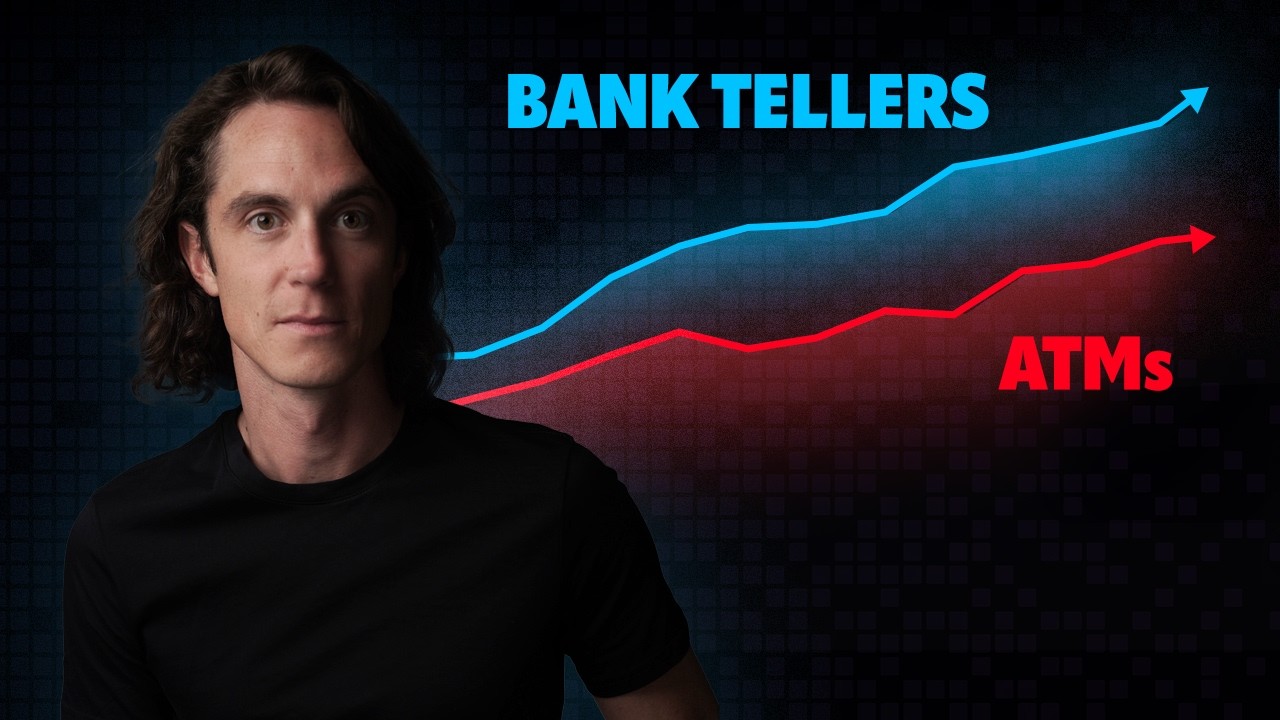

Intro0:00
This was the first viral video: a live stream of a coffee pot. Students at Cambridge got tired of walking up two flights of stairs for coffee, only to find the pot was empty. They built a webcam, hooked it up to the internet so they could see when it was full, and by 1995, millions of people around the world had watched the pot fill up and then empty, showing it to friends and family to describe the internet.
Creating hype that kicked off the bubble everyone is worried we're repeating today: the Dotcom bubble. With each day that passes, more and more people want to know: is AI a bubble? Do I need to take AI seriously, or can I ignore it in peace?
Because deep down, everybody knows that all bubbles have one thing in common, one critical ingredient: a lie that the majority of people believe. There are three things we're told about AI that could be lies. AI will keep getting better.
We need more data centers. A lot of people are using it a lot. If we want to know if one of those is a lie, we have to understand what the lie of the Dotcom bubble was. Have you ever heard of Dark Fiber?
This video is sponsored by Public.com. More on them later. The internet would be how we did everything: talk to people, bank, shop, date, watch movies. This was the promise of the Dotcom bubble. The real world was about to move into the virtual world.
Dark Fiber1:01
Everyone believed it, even though almost no one was on the internet. If you were, it was painfully slow, having to wait. And wait. And wait. For one of just a few thousand websites to load, because hardly anyone knew how to build a website.
Web developer wasn't a thing in the 90s. Even if something was built, that thing didn't have a way to get paid by customers. We were still shipping people the internet in the mail. You get this in the mail.
Put it in your computer, plug your computer into a phone outlet, and then you could connect to the internet. Sending data back and forth over telephone wires that were absolutely not built for it. Not built for video of a coffee pot to be sent from England to the U.S.
These copper telephone wires could carry 100,000 times less information than this cable. Made of very long, thin strands of glass, fiber optic cable could carry more information thousands of miles compared to copper's five. This copper wire was the bottleneck at the beginning of the internet, and this fiber optic cable was the actual bubble of the Dotcom bubble.
It wasn't the software. It wasn't the websites. This cable was the foundation for the lie everyone believed. Eerily similar to what's happening with data centers today, except in one critical way, which I'll explain in detail here in just a minute.
Companies in the 90s started laying as much fiber optic cable as they could get their hands on. Much, much more than we could possibly use. The U.S. data network is a series of cables that form a mesh around the country.
Starting as basic telegraph lines, each cable was made of one iron strand. The data required for phone calls to work forced every telegraph line to upgrade to two copper strands. By 1995, the two major cross-country cables running from New York to LA had been swapped out for fiber optic cable, with branches running to regional hubs.
That was more than enough for what we were doing at the time. What was used mainly went to phone calls. A tiny, tiny sliver went to the people browsing the early internet and the few thousand websites it had.
But as the Cambridge coffee pot made the rounds, as the hype began to build, people looked back at what happened when the network went from telegraph messages to phone and said, "Fiber optic cable. More of it. Right now."
Just five years later, 13 new cross-country fiber optic cables had been laid. Companies were announcing their plans and, almost overnight, raising billions to lay more fiber optic cable. The route from Houston to LA went from having just 1 to 5.
New York to Washington went from 2 to 10. The United States to Europe went from 3 to 12. By 2001, $500 billion had been spent laying all this cable, but not one of those dollars was spent doing the hard part.
What was desperately needed, required for the internet to take off in a meaningful way: the last mile. Replacing the couple of miles of telephone wire that ran from each and every house to the central office where the fiber cable stopped.
How were the millions of homes that were going to be expected to be the backbone of demand for the internet supposed to browse the web at high speed if the cable from their home to the end of the fiber optic cable was still telephone wire?
How was Pets.com supposed to get everyone to its website if they were all still on dial-up? By 2001, less than 10% of all that fiber optic cable was being used. Unlit by information moving through it, the other 90% became known as Dark Fiber.
People noticed. Investors noticed. The internet was not ready. Internet companies were left hanging like everyone else, well aware that unless homes could access the internet easily and quickly, people would never use their product. 100 milliseconds feels like this.
One second feels like this. An enormous body of research shows 10 seconds, and almost everyone will abandon a computer task. Sites routinely push past 30 seconds to load in 2001. But to really seal the deal, maybe the critical reason homes needed to be moved off telephone wire?
Are you on the internet again? Get off. I've got to use the phone.
Homes overwhelmingly had just one phone line. Connect to the internet and your phone didn't work. Couldn't call anybody. Couldn't receive calls. Just a busy signal. Anybody that lived through this period remembers the family fights this would create.
The bubble popped.
Dragged down, not by web companies, but the telecom companies who dumped hundreds of billions into fiber optic cable that wasn't being used. These companies didn't just fall a bit. No, no, no, no, no. They went to zero.
The once-mighty Enron Corporation now heading into chapter 11.
Full bankrupt. Half a million telecom jobs disappeared. The stock market followed, shedding 50% in 18 months, and the economy went with it. Sounds familiar,right?
Are we going to have an AI bubble? That's the last question.
Concerns about an AI bubble.
Is the AI bubble popping?
Companies are taking two approaches. Some are building their own data centers.
For AI to be a bubble, there must be a lie. So here are the three things claimed as truth that, if they turn out to be lies, the bubble is going to pop. But if they don't turn out to be lies, this AI thing might just be getting started.
AI will keep getting better.
Getting smarter5:58
You know this word, but you don't just know it. You understand everything about it immediately. How the sun relates to Earth, the two planets closer, the five planets after, that they circle the sun. You see that and your brain immediately spawns all the bits of information that are relevant to you knowing the word is third.
This is not how AI works. AI just knows the word is third. It does not know. It does not care to ask. The word is third. It's the third planet. The third planet of how many? To get AI to know the word is third, we've taken all the text humans have ever created.
Every website, book, post, every single word of that text is changed from text to something that looks like this. Then a random chunk of all that text is chosen, a word is removed, and shown to the AI model for it to guess what the missing word is.
It chooses some options and says, "I think it's one of these four. This one is my top choice." The correct word is revealed to it. If it got it wrong, the assumptions it used to choose what it did are adjusted.
Its guesses are put back, and a new random chunk of text with the word missing is shown to it. It guesses, updates its assumptions over and over and over, billions of times. This is why it's called training. Like a giant glorified flashcard session.
Once it's seen enough flashcards, its assumptions finally tune, starts to continuously get the answersright. That's when it's released to the public. Just the assumptions. Those numbers that tell it how to guess. That's the model. So when we say a new model has been released, it's a file of assumptions that have been refined by an enormous amount of flashcards.
The smartest child that has ever existed. And it is in that where you can choose to take a cup half full or a cup half empty view of whether or not AI will keep getting better. Because you were not your smartest as a child.
You will not reach peak intelligence until somewhere around 70. First learning language through repetition, hearing it, speaking it. You were forced into math as you went through school. As time goes on, you start to see connections between things that are different but similar, like flashcards and training AI.
It might seem incredibly smart. We might call it the smartest child, but that's because we take for granted what a child really knows. A child knows what rain feels like. That water from a cup will spill if you don't drink it slowly.
When to start running to kick the ball. How much a piece of paper weighs. Every hour they've spent alive, they've spent interacting with the physical world. They don't know what gravity is, but they know what it feels like.
If you show them this, just like you, they immediately know what it feels like and what it tastes like. You can estimate how much it weighs. You've felt one before. Allowing you to connect what you've experienced to the data you get just from looking at it.
Do you know how much information you get from your eyes? Beamed into your one screen on game day, you see one angle of the game at a time. The standard side angle, sideline angle, from above, cross field, down field.
Most being shot on the workhorse camera of NFL broadcasts, the Sony HTC. Twelve of these that each cost about $80,000 are constantly running to make sure every frame of action is captured, ready to be shown at a moment's notice.
But only shown when someone in the control room calls out, "Stand by camera two. Take camera two." The feed clicks over from one camera, which continues to run, to a different one. As this repeats over and over throughout the game, your two eyes are gathering almost the same amount of data as those twelve cameras combined.
If you were to hook those twelve cameras and your eyes up to identical hard drives, both hard drives would fill up at about the same time. That's how powerful your eyes are. And why the vast majority of people involved in making AI better see the glasses half full.
Text is very useful, but just scratches the surface of actual knowledge. Humans can estimate distances, predict how a shadow will move, generate an idea of what the other side of a rock might look like, even if we haven't seen it.
Let me show you something.
This is an image of the largest gold nugget ever discovered. You haven't seen the other side of it, but if you imagine it in your head, what you come up with will be far better than what AI comes up with.
Because if I ask it to rotate this gold nugget around its y-axis 360 degrees, as soon as it has to imagine what might be on the other side, utter failure. It's never encountered the other side of this gold nugget because, unlike a word, sentence, or even paragraph, it is truly unique.
But you have played or handled thousands of rocks enough to know that they don't do this when you turn them over. How would AI know unless it's seen a bunch of rocks? Revealing the gap between how smart AI can be and where it is today.
Vision, touch, smell, sound are all far more information-dense than text. Splitting the question of will AI keep getting better into two parts: can it and will it? It can, but will it play with thousands of rocks becomes a question of...
We need more data centers.
Some of you may not have heard this yet, but our sponsor, Public, just launched something called Generated Assets, and it brings AI into investing in a way I've honestly never seen before. Here's how it works. You type in an idea like AI-powered supply chain companies with positive free cash flow or defense tech companies growing revenue over 25% year over year.
Public's AI then dispatches a swarm of agents that scan every single U.S. stock, evaluates them, and instantly builds a complex index around your thesis. What really stands out is how clearly it explains why each stock is included. And before you invest, you can even back-test your idea against the S&P 500.
So you're making decisions with real context, not just guessing. And beyond Generated Assets, Public lets you invest in stocks, bonds, options, crypto, all in one place. They'll even give you an uncapped 1% match when you transfer your investments over from another platform.
If you want to build a portfolio that actually reflects your thesis, visit https://public.com/max. Paid for by Public Investing. Full disclosures in the description.
Data centers11:36
We're building multiple multi-gigawatt data centers.
Building these giant AI factories.
I do guess that a lot of the world gets covered in data centers over time. Maybe put them in space.
We're going to start building these giant gigawatt data centers in space.
The world needs a lot more processing power. The size of the site covers a significant portion of the footprint of Manhattan in terms of space.
But why would you need a data center of that size? What could possibly be the logic for a building the size of Manhattan? Manhattan is 23 square miles. Inside a data center the size of Manhattan, there will be 5,000 rows.
Each of those rows will contain 50 racks. In each of those racks, you'll find about 70 chips. Every word you ask AI to predict, the math it takes to predict just that one next word is spread out across many chips.
Each chip takes part of the problem. They combine their work, and out comes the word. Dozens to hundreds of chips fire off for each word. Not each question you ask. Not each conversation. Each word. This is the reason Nvidia cannot keep up with demand.
It cannot produce enough chips for all the words people want predicted, for all the images and video they want created. This is the critical departure AI takes away from the dotcom bubble. All of that fiber optic cable that was laid was not being used.
It was Dark Fiber. You cannot get your hands on an Nvidia chip because every single one of them is running around the clock at such high capacity and without break that occasionally one melts. There is not a dark Nvidia chip in the countryright now.
This is how a word is represented in AI. What's called a vector. It is, just like on paper, one-dimensional. A section of an image is represented like this: two-dimensional. One for width, one for height. This is how video is represented.
Height, width, and then one for time. Three-dimensional. One frame of video footage is 1 million times more information-dense than an average word. Or to put it another way, two seconds of video contains about as much raw information as the entire Harry Potter book series, which is why these data centers that seem eye-watering in size are what every tech company is scrambling to build.
They are looking way past the chatbots we all play with and what it will take to make a reasonable prediction at what the other side of this gold nugget might look like, egged on by this one paper that kicked off this whole thing in 2017, that was written about text but was found to be just as useful in virtually every other type of data.
It's not if it will work. It's how to build enough processing power for doing the math. And here is where it would be reasonable to maybe raise a red flag and say, "I have found the lie." Maybe. Because we need more data centers is really code for we need more electricity.
Flip every single power plant on. Turn the sun on bright. Make the wind how. And this is the total amount of electricity the United States can generate at any given moment. But of course, some power plants are down for maintenance.
Clouds are out today. The wind is calm. Making this the realistic amount of electricity we could generate if we went full blast. A place grid operators never want to be. So they bake in room above the spot where electricity demand always peaks midday during a brutal heat wave.
To build all the data centers that have been announced, that room operators require the safety margin. It almost evaporates. Not just sometimes, forever. 24 hours a day, seven days a week. It must always be on because data centers don't turn off.
Mix and match however you like. The amount is equal to 100 nuclear plants, tens of thousands of square miles of solar panels, plus batteries, half of Texas worth of windmills. This doesn't happen. Electricity demand doesn't grow this fast.
Has never grown this fast in the history of humans. Scrambling to find electricity to the point of turning the infamous nuclear planet Three Mile Island back on, or taking on all the complexity of having their own power stations built, they have this paper.
They know it works. Everyone else has this paper. Everyone else knows it works. So just like an arms race where countries race to have more firepower than the other, can't fall behind. Every tech company feels forced to do whatever it takes to solve the electricity problem.
That is, for the moment, the telephone wire problem of AI. But if the electricity problem cannot be solved, all the expectations for what AI will do, the products companies will sell, the amount of money these companies have become worth, it all gets called into question.
It can be done. We know how to do it. It's not a full red flag. So maybe, for now, we just raise a yellow flag.
Everyone is using it. A lot.
Everyone's using it15:51
They found that if you used it just three times in one week, 95% of people would never stop using it. They were in for life. Look at how clunky these were. This is '97, '98. Dozens of companies trying to bring order to the internet.
But this, all this, that's not really why you were here. You just wanted your question answered. One box, two buttons, and ten blue links. Powered by a new idea that said, you know what people will probably wantright at the top?
The pages that have the most other pages on the internet linking to them. We'll call it PageRank. So simple. So good. Once you tried it, you did not go back. Out of 100 people that would try it, 95 became permanent users.
The only other products that have come close to Google search for getting people to stick around: Facebook, Instagram, Uber, and WhatsApp. But even those fall miles short of Google's 95%. So for those in the AI world, it was mildly concerning when ChatGPT wasn't anywhere on the list.
A lot of people tried it. A lot of people never came back. But then something that rarely happens happened. People who had dropped off five months before started coming back to try it again. This is not a thing.
This line, what we call retention graph, it never goes back up. Once people try something and ditch it, they do not come back. How many unused apps do you have on your phone? So a version of this chart started swirling around social media.
ChatGPT had gotten users to come back, yes, partially because their model had gotten better, but also because they said, "Hey, there's this other tier of service we offer. It does more. It's much smarter. You can have it, but you've got to pay for it."
Turns out people wanted more. They wanted smarter. They were thrilled when they could pay to have more. Signaling to everyone that, "Hey, yeah, building data centers, let's do it. Definitely. Build them as fast as you can." But then, just a few months into the excitement, this happened.
China's latest AI breakthrough has leapfrogged the world.
DeepSeek shock17:35
Let's talk about DeepSeek because it is mind-blowing.
I wonder whether DeepSeek has kind of changed. I mean, it feels like it's upended the race this week.
A completely unknown Chinese company released this paper that showed the world that actually, we can do that, what you're doing, but with just a tenth of all the chips you're throwing at it. We're just 15 guys in an office.
Not even really a tech company. We're a hedge fund. Cue the panic.
DeepSeek's claims that it built an AI model for less than $6 million. Not a B. Million dollars.
Down big, especially the tech-heavy Nasdaq.
Shares in the advanced computer chip maker Nvidia plunged overnight.
Nvidia dropped 17%.
Nvidia just erased $100 trillion in market capital.
All because of DeepSeek.
Many thought this was a crystal-clear new signal that, "Hey, data centers." No. No good. Shut it down. Unable to put themselves in the shoes of the people who know the difference between how a word, image, or frame of video is represented for AI.
People who immediately thought, "Huh, that's interesting." I wonder what happens if we take that and use all the chips we have instead of just the tenth they used. This whole thing will probably get 10 times cheaper. And so it did.
Now those people happy to pay for more could get 10 times more for the same price. Revealing one of the keys to truly understanding how people actually behave. If something gets cheaper, we don't choose to use the same amount of it and pay less.
Jevons' Paradox18:57
No, no, no. We choose to pay the same amount and use a lot more of it instead. What's called Jevons' Paradox.
On average, one whale had 2,000 gallons of oil in it. Oil that was, just like electricity today, the way people lit their home. Except that enough whale oil to keep one lantern lit every night for one year cost $1,200 in today's money.
Making hunting whales an extremely profitable yet brutal profession. Find a whale, harpoon it, pull it to the side of the boat, strip the blubber off, cut it into pieces, boil the pieces, and out would come liquid gold that would arrive at city ports on ships that, by the time crude oil was discovered, had to stay out on the water for three or four years before they had found enough whales, forcing all but the most wealthy to go without light once the sun went down.
Until a guy figured out how to make kerosene from oil. At a tenth the price of whale oil, houses went from maybe one lantern to a kerosene lamp for each person. Kerosene gave way to cheaper electricity 70 years after that.
A lamp in each room turned into dozens of light bulbs throughout a house. To today, where people have more lights than they know what to do with. Just like the car, refrigerators, coal, oil, farming. Jevons' Paradox frames the story of every major technology.
Humans like stuff. Comb through the data, look at the slides, and you will see chart after chart that looks like one of these. That shows one year after the DeepSeek incident, AI use has increased 50x. Not 50%. 5,000%.
The forest20:23
When you think about what AI is today at its core, it is a repackaging of something people were using incessantly before any of these LLMs came about. It's just repackaging the data we were all consuming before, using the same cables, same protocols, same devices.
It is even, with a few exceptions, the same companies. The giant redwoods in the forest, unfazed by storms, high winds, or the occasional drought. While the AI startups are the seedlings scattered throughout, trying to find enough room to grow to become one of the giants.
Most won't make it, but the forest will barely notice. If bubbles have a second trait they share, it's that the thing being promised is new. A green field. The start of the internet was a new fragile thing. How do we use this thing?
A bright green field with trees just starting to sprout up. Today, it is a massive thriving forest. And this thing we're calling AI is that same forest expanding. The giant redwoods getting taller, new trees being born. So if the electricity gap isn't solved, a raging wildfire rolls through here.
But if it is, with the number of people using it, the headroom for it to get better, the idea that today, now, AI is a bubble that's about to burst like the dotcom bubble, is likely missing the forest for the trees.