
Amazon
CompanyA company discussed on Maxinomics.
3 episodes
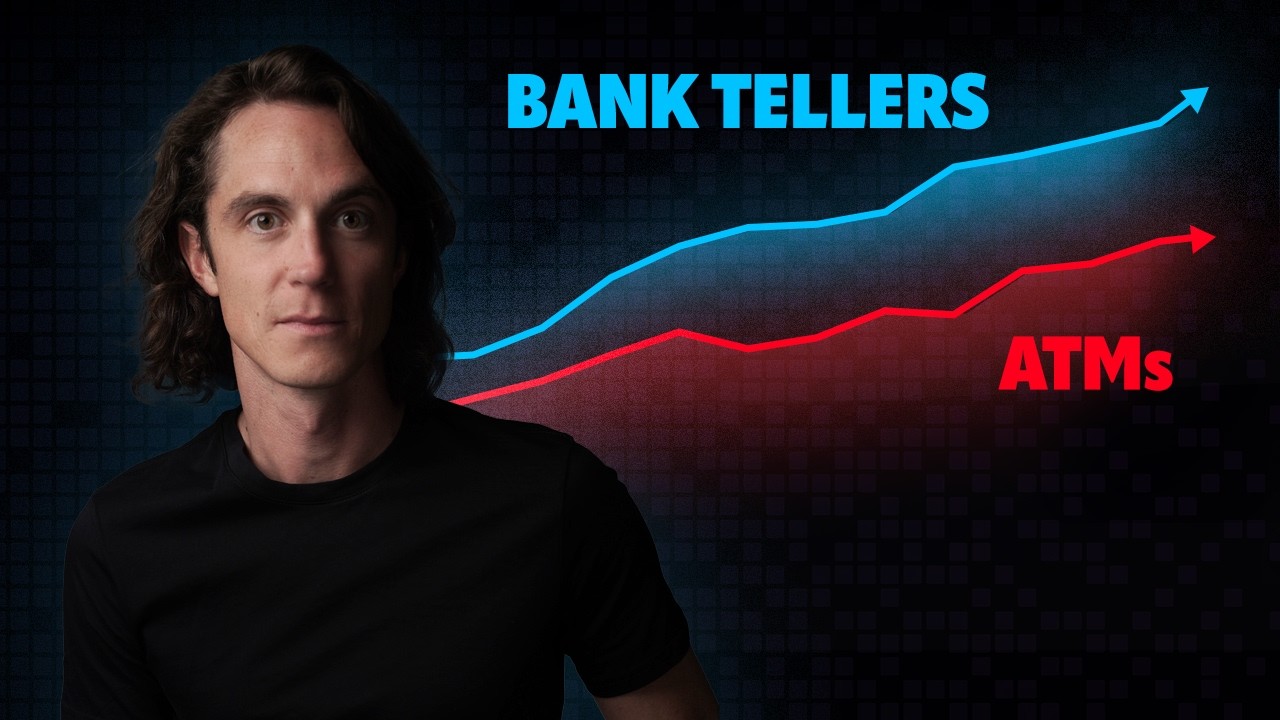
AI Was Supposed To Take Your Job. Why Hasn't It?
Jul 1, 2026 · 20:23
Phil Andrews argues that AI tools like Claude and ChatGPT probably won't take your job, but someone using AI will if you don't use it. Opening with the 1967 debut of the ATM at Barclays, he shows bank tellers instead doubled over the next 50 years, peaking in 2007. Of every occupation title tracked by the U.S. Census over 60 years, only the elevator operator was fully eliminated by automation, while autopilot made airline pilots ten times more numerous. Citing MIT economist David Autor's research, he notes 60% of today's jobs didn't exist 50 years ago, because inventions that make work more valuable create new jobs rather than replacing workers. Using his 3D-printed Maslow's hierarchy pyramid, built with Claude, he explains competing against non-consumption, and footnotes that elevator operators retired because modern skyscrapers like the Burj Khalifa demand computer-managed elevators.

How SpaceX Is Making America Uncatchable
Jun 10, 2026 · 24:50
SpaceX, carrying 90% of everything launched to orbit this year, is selling the coming back: from caravels to railroads, frontier fortunes went to whoever could return, not just depart. Frontiers reset Maslow's hierarchy to survival, making picks and shovels the most durable business. Useful space is tiny: Low Earth Orbit, where Starlink's 6,000+ satellites block rivals, Geostationary Orbit's 1,845 slots, and a Switzerland-sized ice patch at the Moon's south pole. Ice is water, and its oxygen liquefies into rocket fuel, so whoever builds the Moon's first gas station controls the only refueling point before Mars—why Jeff Bezos' Blue Origin, Amazon, and China race to get there. With Planet Labs' satellites and the rocket equation, it weighs generational wealth against a dot-com bubble.

China Will Never Beat Taiwan, Here’s Why
Mar 27, 2026 · 22:54
This episode argues that Taiwan Semiconductor (TSMC) built an uncopyable monopoly—the "Silicon Shield"—on an island whose hostile geography and geopolitical limbo forced it to out-engineer the world. It traces how Taiwan, expelled from the UN Security Council in 1971 in favor of the People's Republic of China, pivoted to chipmaking, adopting the just-in-time system Japan used to beat Detroit and packing 530 companies and 20 fabs around Tsinghua and Chiao Tung universities in Hsinchu Science Park, which makes essentially 100% of the most advanced chips. The episode claims Taiwan's typhoons, droughts, and earthquakes on the ring of fire drove a discipline that yields more than 8 working chips per 10 while Samsung can't hit 5 and Intel reaches maybe 7. Morris Chang's foundry model—never designing a chip, only manufacturing—won Apple after Steve Jobs' fury at Samsung copying the iPhone, and Apple's role as anchor tenant co-develops each generation, keeping Taiwan semi years ahead as a neutral "Switzerland" every country depends on.
Powered by PodHood